The GameAbraham CruzvillegasMay 1 – July 3, 2027
The GameAria DeanFebruary 20 – April 25, 2027
The GameMonika BaerDecember 5, 2026 – February 14, 2027
The GameSeptember 26, 2026 – July 3, 2027
Yoshitaka AmanoOrigins 始源September 26, 2026 – February 7, 2027
Arakawa and Madeline GinsThe Poetic JumpSeptember 26, 2026 – February 7, 2027
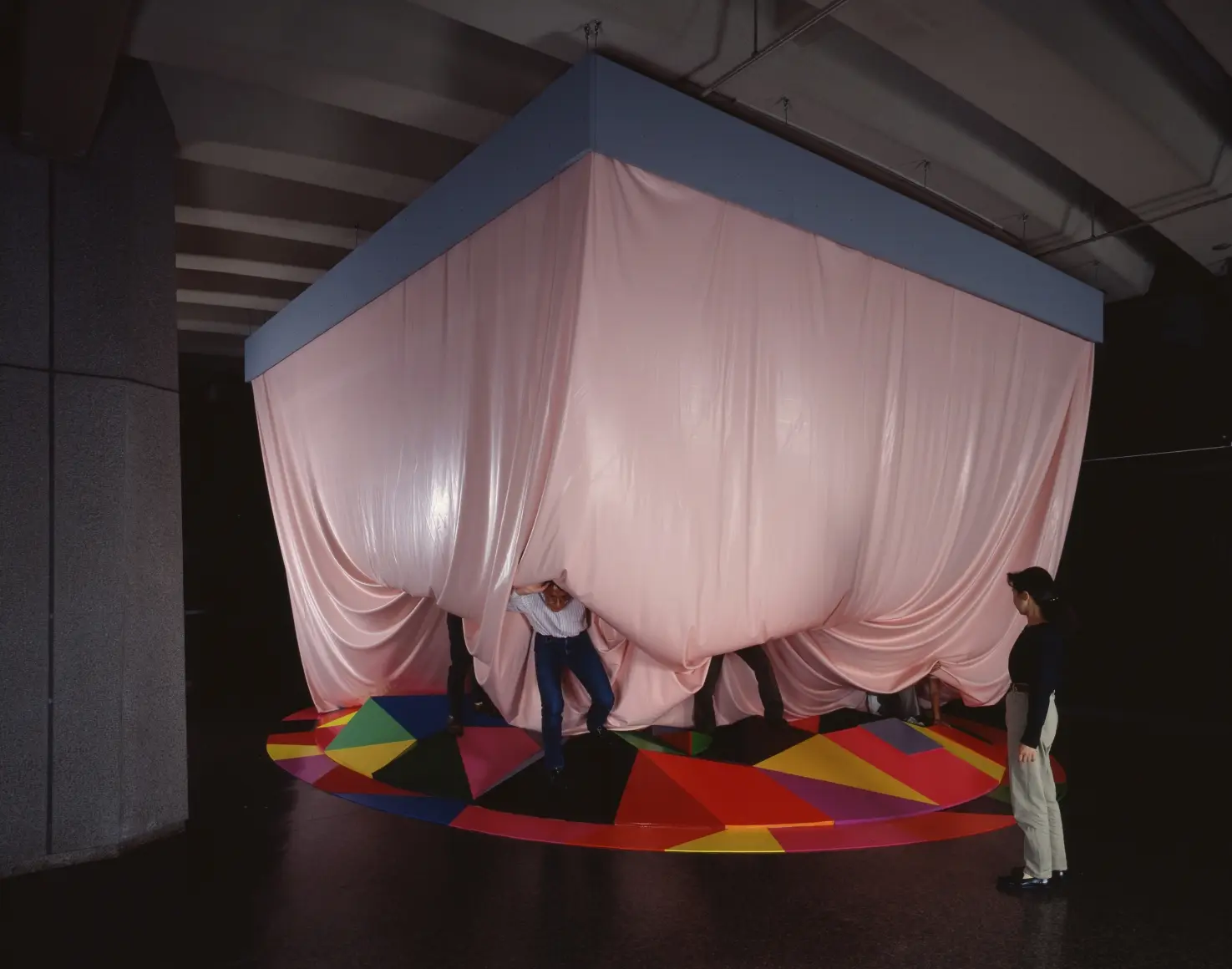
When Arakawa and Madeline Gins befriended Marcel Duchamp in the early 1960s, Duchamp carried a small scrap of paper bearing the words “D’ailleurs, c’est toujours les autres qui meurent” (Besides, it’s always other people who die) in his inner coat pocket. That phrase ended up on Duchamp’s grave, a pretty good joke about how foolish it is to pretend we can punt death beyond its inevitability. The whole of Arakawa and Gins’s practice—spanning architecture, art, film, philosophy, and writing—lives in the humor of that punchline. The paradoxes that populate their work speak to what both artists described as one of the most significant events in their lives: meeting one another, falling in love, and discovering death anew. Under those circumstances, a joke may be the only reasonable response.
Arakawa and Madeline Gins: The Poetic Jump surveys Arakawa and Gins’s personal and creative partnership, and how it led the duo to question “the mistaken concept of the unavoidable death.” Like many of their peers in the New York avant-garde, Arakawa and Gins probed the workings of human consciousness. By the 1990s, their unique visual-philosophical investigations led the pair to what they called “procedural architecture,” installations and buildings that could reverse humanity’s destiny. Arakawa and Gins designed this Reversible Destiny Architecture, with its undulating floors, distorted spaces, and bright colors, to destabilize the senses and recompose human vitality. If we take them at their word, they created sites where one can “learn how not to die.”
This exhibition invites you to enter the pair’s absurdist frame. Paintings, poetry, film, and an installation offer places to situate oneself and experience what reversible destiny might be all about. For instance, you can roam in darkness over the uneven floor of Ubiquitous Site X (1987–91), one of the duo’s early installations. Inside, you may discover what Arakawa and Gins meant by this demand: “We ask that sooner, later, after, and always, justice be done to the poetic jump.”
Arts and Letters commissioned a work of short fiction, Love of Houses, by Renee Gladman, which accompanies the exhibition as part of our Reader series. It inhabits one of Arakawa and Gins’s architectural projects, Bioscleave House (Lifespan Extending Villa) (2008).
Arakawa and Madeline Gins: The Poetic Jump is curated by Noa Wesley, Assistant Curator.
Support for this exhibition is provided by Castelli Gallery. Special thanks to the Reversible Destiny Foundation.
Major support for contemporary exhibitions at Arts and Letters is provided by Patrick Collins.
Arts and Letters exhibitions are also made possible by the Childe Hassam Fund, the Eugene Speicher Fund, the Huntington Exhibition and Museum Fund, the Wolf Kahn Foundation, and members of Arts and Letters.
The GameChristopher Williams: Provisional Props and Blocking TemplatesSeptember 26 – November 29, 2026
For prior exhibitions please write to info@artsandletters.org.